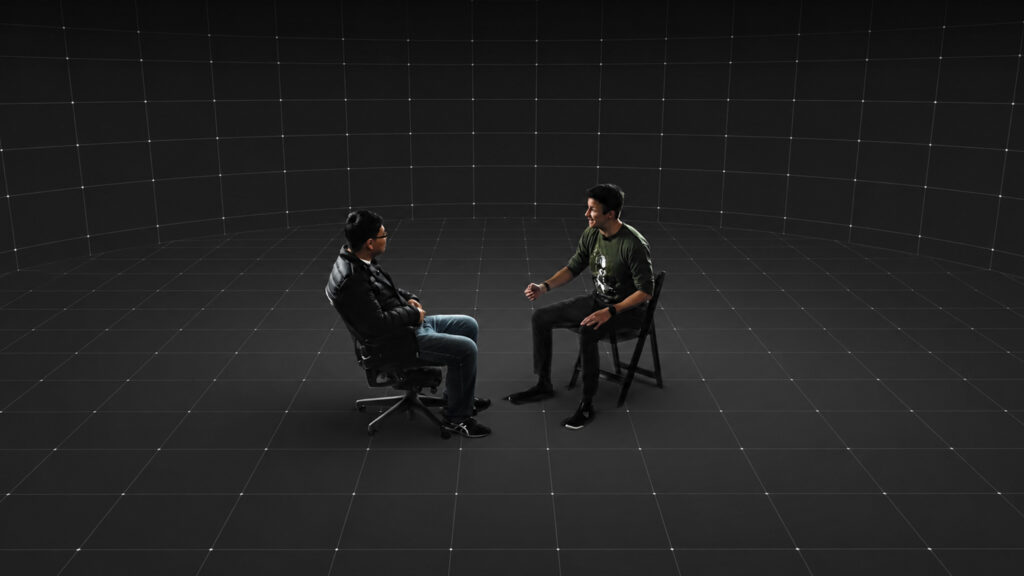
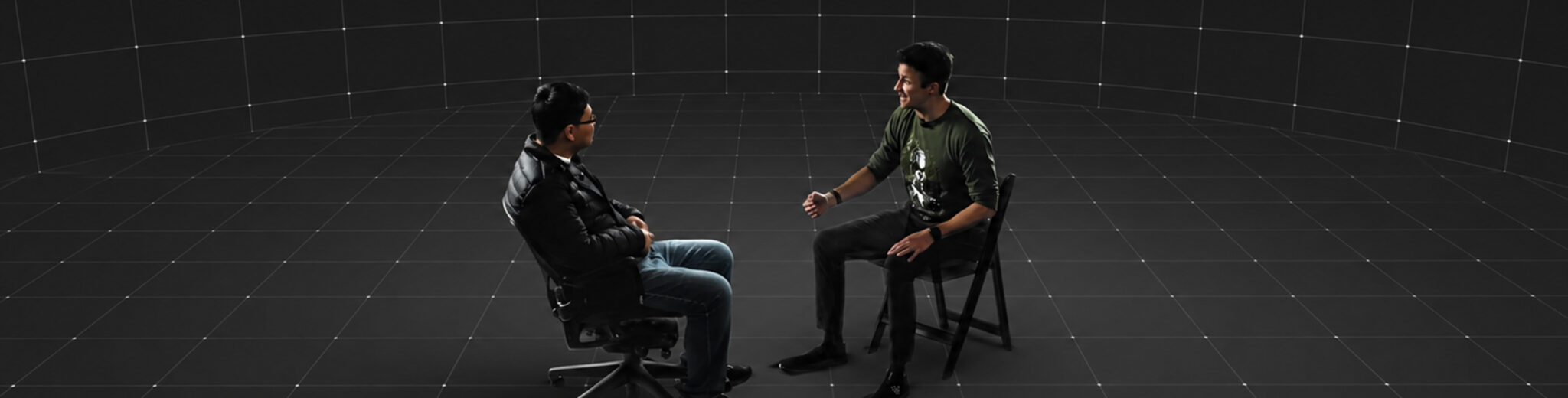
What if a livestream were no longer a flat screen, but a space you could look through? What if you could view an action from every angle, approach a product digitally or see a speaker as spatially present instead of in a webcam window? 4D Gaussian Splatting points exactly in that direction. At Valo, we follow developments like these because they force us to rethink the future of live communication.
From flat video to spatial video
A regular livestream is usually directed from fixed camera positions. The viewer sees what the director chooses: a speaker, a presentation, a product or an action. With techniques such as Gaussian Splatting, that starting point changes. A scene can be captured as a photorealistic 3D reconstruction. The 4D variant adds movement and time. That creates not only a 3D image, but a moving scene you can virtually move through.
Text continues below the video.

Corridor Crew shows why this is fascinating
In the video “THIS is the Biggest Thing Since CGI”, Corridor Crew shows exactly why 4D Gaussian Splatting captures the imagination. You do not see classic CGI and you do not see a regular recording, but a photorealistic 3D reconstruction of reality that comes to life in real time. The camera is no longer fixed to one position. You can look around afterwards, choose new angles and even move through time. That makes video feel much less like a recording and much more like an experience.
Text continues below the image.
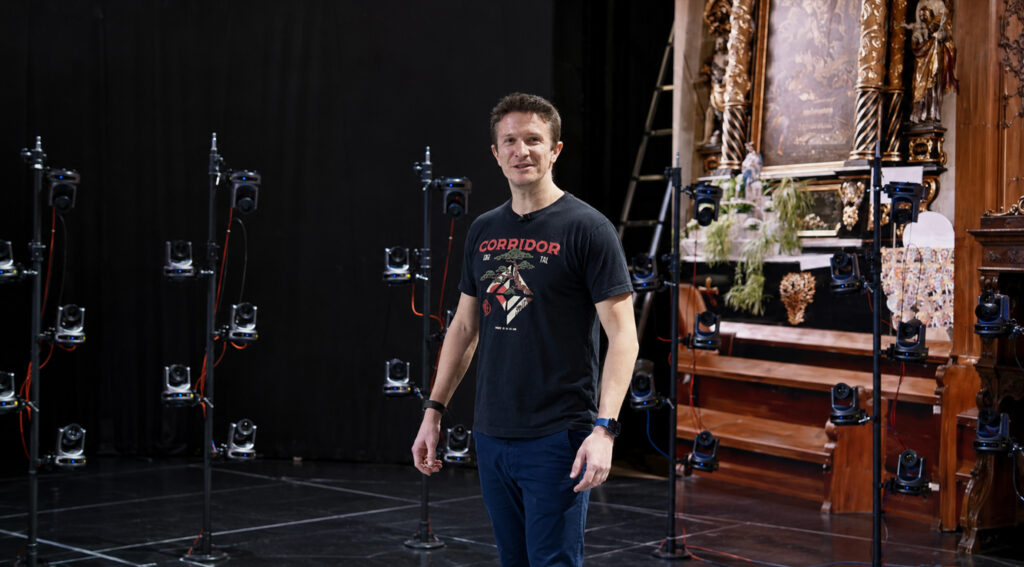
In the image above you can clearly see how such a recording is created today: someone is scanned in a room full of cameras. That image matters because it immediately reveals the reality behind the hype. This is not yet a simple webcam solution for every webinar. It requires a lot of equipment, data and computing power. But that setup also makes it clear how fundamentally different this technique is. The person is not just being filmed, but captured as a moving 3D scene.
Text continues below the image.
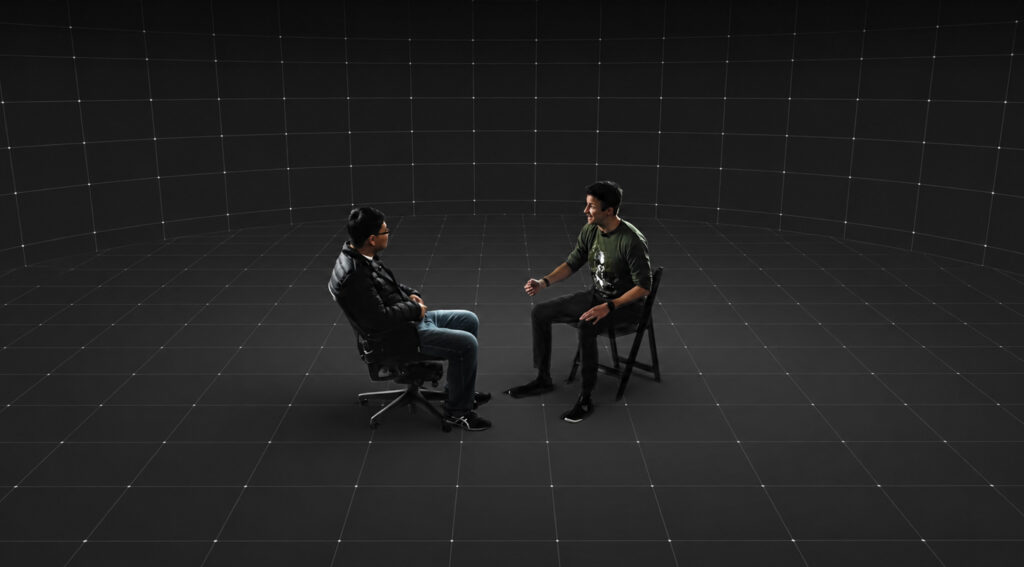
The image above shows the live 3D Gaussian Splat itself. The person is no longer a flat video image in a window, but a spatial presence you can virtually move around. That is where things become interesting for live communication. What if a remote speaker, trainer or expert no longer just dialed in, but appeared as a 3D presence in a digital studio?
The Verge places Gaussian Splatting in a broader context
A good additional source is the article “The tech to build the holodeck” by The Verge. In it, Gaussian Splatting is not presented as a standalone gimmick, but as a technique that could play a role in AR, VR, 3D scanning and photorealistic spatial media. Especially interesting is that major players such as Niantic, Google, Snap and Meta are working on it. That shows that this development is broader than visual effects or experimental video alone. It fits into a larger movement in which digital content becomes less flat and increasingly turns into something you can look around in, move through and interact with more deeply.
Use case: viewing a chef from every angle
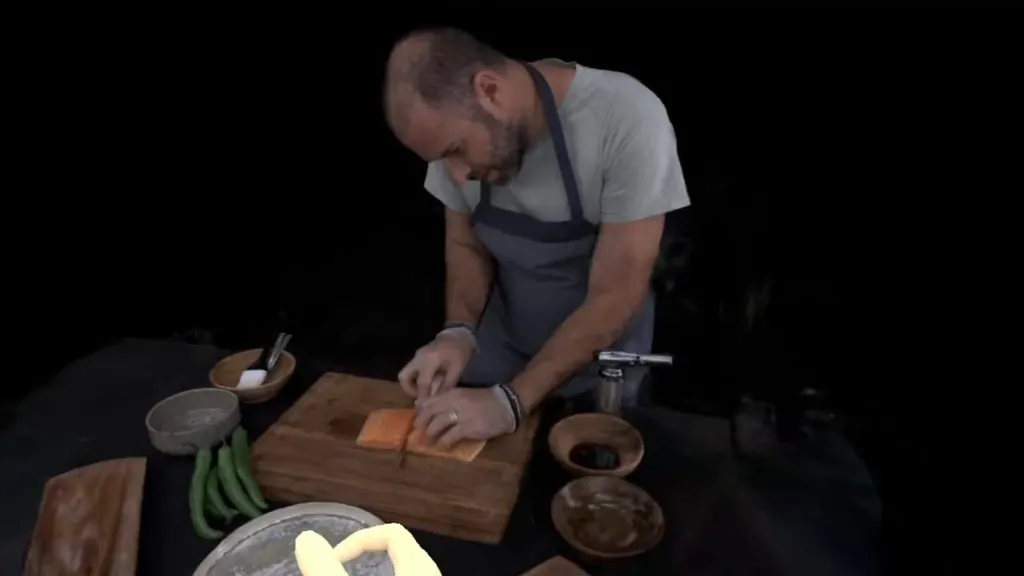
A strong example is Gracia AI, which uses Gaussian Splatting for volumetric 3D videos you can watch in VR. In the example “Let him cook”, a chef is captured with a professional multi-camera setup while preparing a meal. What is interesting is not only that this looks impressive, but especially that you are not stuck with one camera angle as a viewer. You can look around the action, move closer and inspect details such as how someone cuts, moves or prepares something. That immediately makes it clear where this technology can become valuable: not for every conversation or every presentation, but precisely for situations where perspective matters. Think of cooking, training, medical explanations, product demos, technology or any action where you would really want to say: “show me that from the other side.”
Text continues below the image.
When do you want to be able to see something from every angle?
For live communication, this becomes interesting in situations where you really need to show something. Think of a product demonstration, a technical repair, a medical procedure, a safety training session, a sports analysis, a cooking demonstration, a machine in operation or a physical performance. In these types of applications, as a viewer you sometimes do not only want to see what the camera happens to show. You want to look around. You want to understand how the parts relate to one another. You want to review a movement, pause it, zoom in and perhaps analyse it from another angle. That is where the power lies: video changes from a recording into an experience.
More immersive when the space really adds something
The second reason is immersion. A 3D livestream can give viewers the feeling that they are closer to the situation. That matters for hybrid events, training sessions and product launches. But we also have to stay critical. Not every event is improved by 3D. A board update, town hall or panel discussion benefits above all from clear content, strong direction, interaction and reliable sound. 3D only becomes valuable when spatiality truly adds something to the story. The technology should strengthen communication, not distract from it.
Hype or future?
Is 3D livestreaming hype? Yes, if you expect every webinar to come out of your screen as a hologram tomorrow. We are not there yet. At the moment, the technology is still too heavy, too complex and too data-driven for ordinary livestreams and online events. But that does not make it any less interesting. Right now, people are working hard on compression, scalability and applications for VR training, education and immersive video. So there is no ready-made standard yet, but there is a clear sign of what is coming: livestreaming will become less flat, more spatial and much more interactive in the years ahead.
The question for organizations
The most important question is therefore not: “Can we already use this in our webinar next month?” The better question is: “What could our communication become if video no longer had to be flat?” Which action within your organization would become stronger if people could look at it from multiple angles? Which training becomes clearer if participants can look around? Which product demo becomes more convincing if customers can move digitally around the product? Which speaker, expert or CEO might in future not only be able to dial in, but also be present spatially?
Our conclusion
We expect 3D can become a valuable addition to existing online events once it truly adds something. Not as a gimmick, not because it can, but because your message becomes stronger.
Where does your story become more powerful when people can look around? Which demo, explanation, training or experience in your organization may one day deserve not an extra camera, but an extra dimension?