Event webcasting has become indispensable in the post-pandemic era. Organizations have come to see the benefits of livestreaming, and invitees have become more selective about attending physical events. Webcasting is therefore more important than ever. In this blog we explain what webcasting is, what the benefits are and which webcasting formats are possible.
What is webcasting?
Webcasting is the live broadcast of an event to a larger audience over the internet. A webcast can consist of video or audio only. The latter is called an audio webcast. Webcasting makes it possible to stream an event virtually to a worldwide audience. With webcasting you can reach a broader target group and connect it to your organization or brand. Synonyms for a webcast also include livestream, online event or online congress.
What is the difference between a webcast and a webinar?
While a webcast primarily focuses on broadcasting to a large audience, a webinar is often smaller in scale. A webinar usually requires participants to register in advance and has an educational purpose. A webinar creates room for interaction between participants and there is an opportunity to ask questions via chat. A webinar can therefore be defined as an online, interactive knowledge session that is broadcast live for a limited group of participants.
In a webcast, a high degree of personal interaction is more difficult because the broadcast is larger in scale. A webcast is often one-way communication aimed at conveying information or entertainment. However, there are different tools available to encourage interaction with a large audience, such as using polls and quizzes. So it is certainly possible to create interaction in a webcast, but to a lesser extent than in a webinar.
The text continues below the photo
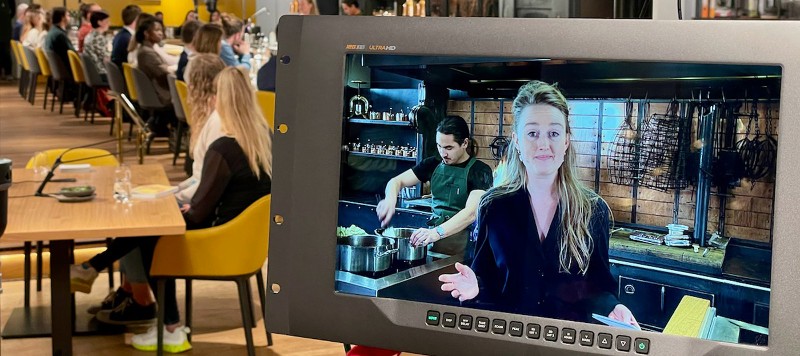
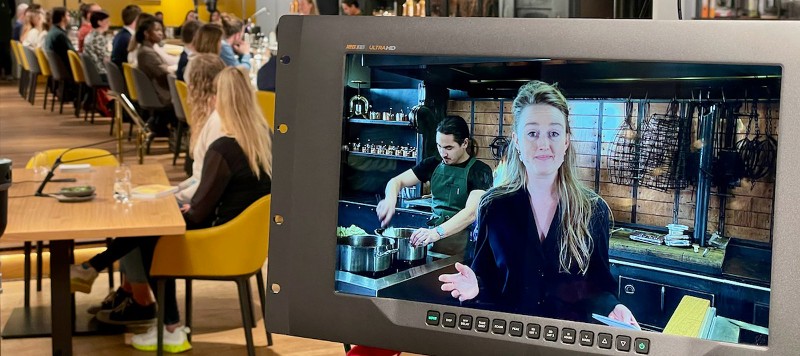
Webcasting a live cooking session with guests dining in for the Week Without Meat
What are the benefits of webcasting?
Webcasting makes remote participation possible, allowing you to reach a larger audience than with a physical event. In fact, almost all the benefits of webcasting are related to accessibility. With webcasting, visitors can attend your event online, making it more accessible for people who otherwise would not be able to participate because of distance or physical limitations. This makes your event more inclusive. A physical event venue also often has limits on the number of guests, so not everyone is allowed to attend. With a webcast, by contrast, there is often no maximum participant capacity (or the capacity is so high that it is not reached).
Another major advantage is that a webcast can be recorded. Not only can interested people who are unable to watch live still watch the event back afterwards, the video content can also be easily reused for marketing purposes or internal training. Over the past ten years, Valo Online Events has organized hundreds of livestreams and advised clients on using video in their marketing strategy. Feel free to contact us without obligation to hear how we can make your webcast a success!
Tip: Reuse your webcast video content
You can edit the recordings of your webcast into separate videos with quotes and standout moments, or create an aftermovie and use it to promote the next edition of the event. You can also use the recordings to create screenshots or written content. That is how you make your video marketing more efficient!
Ways of webcasting and webcasting software
A webcast can take different forms, but is usually based either on a content-driven presentation or on an event. The content-driven presentation is closer to a large-scale webinar, in which the host shares a presentation with informational slides and is also visible on screen. This is often a simplified form of webcasting.
A webcast built around an event is much more complex and comparable to a professional TV production. It switches between multiple cameras and several speakers appear live on screen. Webcasting an event requires tighter planning and direction, because multiple program elements need to flow into one another. Such a production also often involves more people.
Webcasts are broadcast via platforms that offer streaming functionality, such as Vimeo, YouTube and Facebook. The livestream can also be embedded on the organization’s own website, or hosted via a new website created specifically for the event. For a webcast, a professional party such as Valo Online Events is often hired to handle this technical side. They take care of the complete technical setup of the webcast.
The text continues below the photo
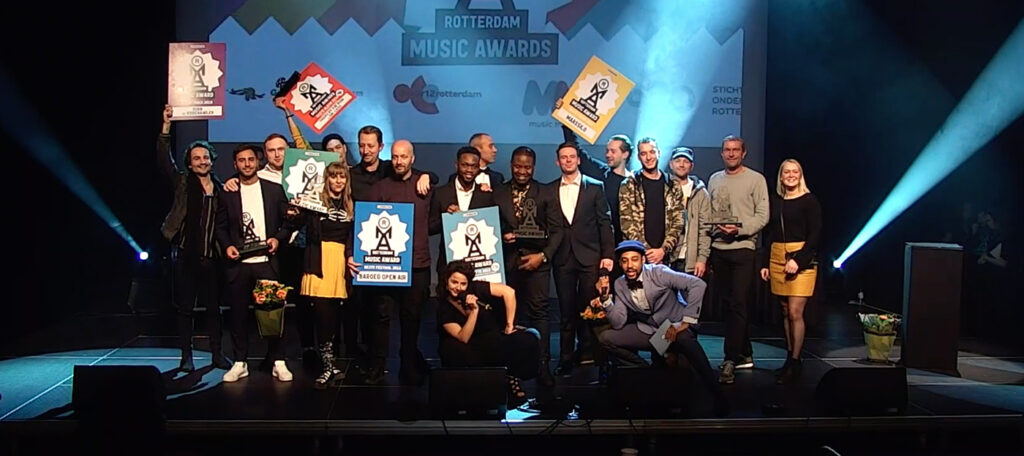
Webcasting an award show: Rotterdam Music Awards
Examples of webcasting
Webcasting is used by a wide range of organizations, from government bodies and commercial companies to foundations and trade associations. Some examples of webcasts are:
Launches of new initiatives or products with a kick-off event;
At Valo, we have more than ten years of experience webcasting presentations and events. You can see great examples of this in our client cases. Do you want to organize a webcast but need advice, or would you like technical support taken off your hands? Then contact us using the form below.