
When it comes to live video, the terms are everywhere these days. Does it make your head spin a little too? We are happy to explain how it works.
What is a livestream?
It all starts with a live video and audio connection: a livestream. A livestream is simply an online live broadcast with picture and sound. Live broadcast, live video and online broadcast are some of the terms often used. In essence, a livestream is always part of a webinar, webcast and web conference.
Real or semi-live
You can livestream your programme directly. Because you go live immediately, you can quickly get your message across and, if necessary, seek interaction. This can be very nerve-racking because, unlike with a regular video recording, you cannot simply do it again. That makes a true livestream a transparent format and therefore a very powerful communication tool.
With semi-live, the programme has been recorded earlier but is broadcast live at a later time. In that case, interaction with the audience is not possible.
A requirement is that the video content is broadcast at a fixed time (live), just as you are used to with regular television programming.
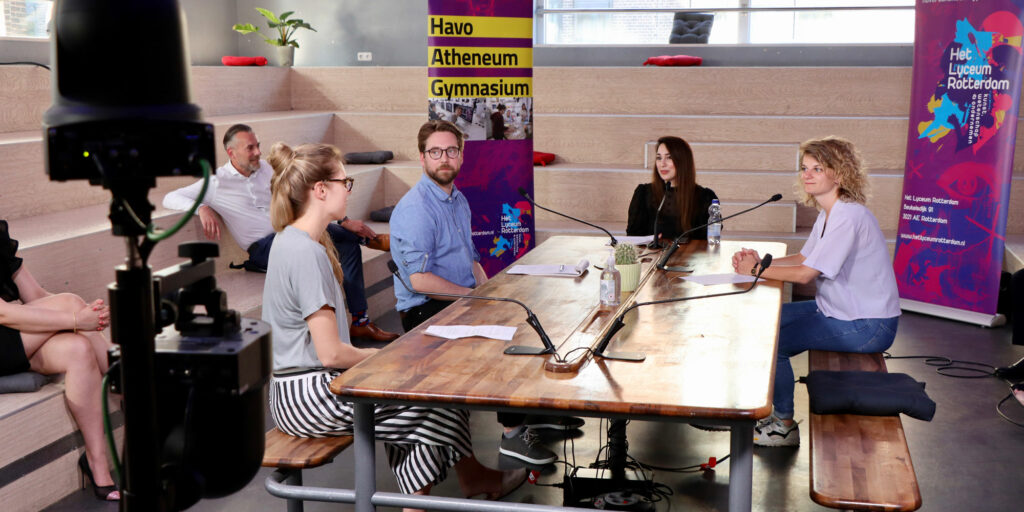
Livestreaming is generally broadcasting to a large audience with little to no opportunities for interaction. At Valo, we often speak of a livestream when we are really programming a talk show with multiple speakers that is broadcast for a large target audience.
Is streaming on Netflix or YouTube also a livestream?
We get this question often. Streaming a film or video on Netflix or YouTube is not a livestream. In this case you stream on demand a film or video that is available in their online database. You watch it whenever you want.
It may be that the live broadcast is later offered as an on-demand video. It is then no longer live, but you can still stream and watch it.